
Suicide Sal
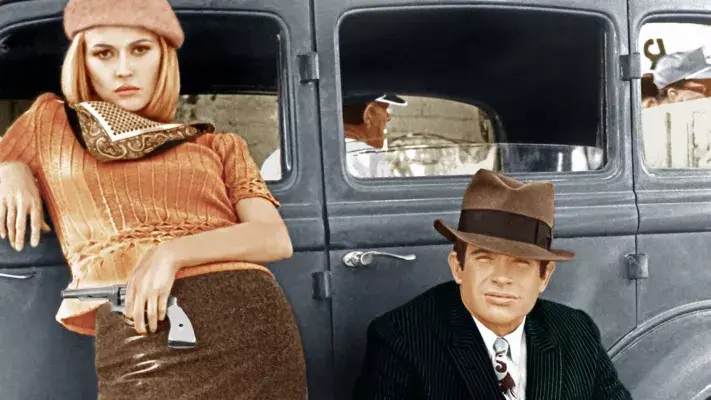
I knew I had to shift away from my best friend Mark when I felt those tears start up in my eyes at the end of the most beautiful movie I’d ever seen. He sat right next to me, baby-faced and bug-eyed, his braces making him look like he was always in the middle of saying something.
I was already embarrassed from when one of the characters, C.W., took his shirt off and I felt my shorts start to get tight. Those two hours I spent with Bonnie and Clyde, my sneakers stuck to the theater floor of a thousand soda spills, were the most important two hours of my life, so far. Or that’s what I thought as I snuck the heel of my hand up and wiped my eyes.
The lights came up and Mark whooped with excitement. “Wow, did you see how they danced when the bullets hit them? Bam bam bam!” That’s what he asked me when describing the horrible slaughter of those two good people. I couldn’t believe he was so cruel. I just looked at my feet while we left the Lake, the movie house named after the street where it sat, and I stayed silent.
It was an old place, built way back in the Twenties, but Oak Park was even older. Marshall Fields on one end, Montgomery Wards on the other—two big department stores bookending the busy street. I walked down it every single day to school, so I knew every storefront like I knew the alphabet. There were household shops and a few lady stores and a fancy candy place. And right next to the theater was Kroch’s, the bookstore where I spent most of my time when I wasn’t at school or the library.
I went back to the Lake that Sunday, all by myself, to see the first showing. I didn’t emerge from that theater until I had seen the movie three more times. I swaggered out of that place, an outlaw, daring anyone to get in my way.
I always loved the movies, but that day, for the first time, I knew I was watching a film. The flickering light felt different, not just a story, but something bigger. And something else weird happened, like a baby chick pecking through its shell seeing light for the first time.
It was Clyde and CW that did it. The way goofy-looking CW always trailed behind, like he belonged to Clyde. And the way Clyde, devil in his eye, looked back at him. It made me wonder what they did when Bonnie wasn’t looking.
The next day on my way home from school, I happened by that record store on South Street and saw they had the Bonnie and Clyde soundtrack. I had to have it! But it would take two weeks’ allowance, and that was all I could think about—a countdown to hearing that music again. Maybe I should take up the banjo?
When I finally bought it, I rushed home, put the record on, and read every single word of the liner notes while the music played. I stared at the black-and-white still on the back cover—Bonnie, Clyde, and Clyde’s very handsome brother, Buck. Then, just as “Foggy Mountain Breakdown” ended, I heard something I wasn’t expecting. The record had dialogue!
I started listening to certain parts over and over, memorizing Clyde’s lines, his rhythm, his swagger. But oddly enough, I was more drawn to Bonnie’s. In the opening scene, one I now knew by heart, Bonnie, bored and restless, leans out her upstairs window and spots Clyde trying to steal her daddy’s car. He grins up at her and invites her for a ride.
"Wait there. I’ll be right down." She fixes the pin curl on the side of her head, then jumps into his car like she was born for it.
"I’ll be ri-i-i-ght down," I repeated, drawing out the words.
I was starting to sound downright Texan.
Shortly after that scene, Bonnie was all over Clyde, kissing him, reaching into his pants, when he shooed her away and bolted from the car. He told her to slow down. I could feel Clyde’s discomfort, though I didn’t know why. She was mad as all heck and spat, “Your advertising’s just dandy. Folks’d never guess you don’t have a thing to sell!”
Now why would Bonnie say something like that? I didn’t know, but I couldn’t stop repeating it.
Mrs. Malone, my bleached-blonde fifth-grade teacher with an unfortunate limp, one she got from a bad car crash, we heard, assigned us to bring a poem into class and read it aloud. By this time, I had a well-worn paperback biography of the real Bonnie Parker and Clyde Barrow. I knew Bonnie was a poet. She’d written three poems in her short tragic life, after all, and I could only imagine what she would’ve written if the law hadn’t cut her down in her prime.
I thought about choosing The Ballad of Bonnie and Clyde, her last poem written just weeks before they were tricked into their death trap. It was brutally honest, and that last stanza stuck with me: "Some day they'll go down together, they'll bury them side by side. To few it'll be grief, to the law a relief, but it's death for Bonnie and Clyde."
Still, I wanted drama, so I went with her epic, Suicide Sal.
I practiced the lines, but more importantly, I practiced my Faye Dunaway. For days, I drawled my words, batted my eyes, and eventually Bonnied my dad into silence.
My mother, when she was conscious, thought I was acting like a sissy. I told her it was for a school project.
“What kind of goddamned school project is that?”
“I’m reading a poem.”
She lit a cigarette, looked away, disgusted.
She didn’t understand the level of commitment an artist needs.
On the day of the reading, I’d written the poem out in cursive on a sheet of lined paper, neatly folded and tucked inside one of my schoolbooks. Safe. Ready. Leslie Gombiner went first. Robert Frost. I smirked. Next was Dan Van Zandt, stumbling through something by Ralph Waldo Emerson. Sheesh Uncreative jerk. Our school was literally named after Ralph Waldo Emerson, for crying out loud!
This class needed a kick in the behind.
I was next. I hated reading in front of people. My throat always tightened up, my chest got that feeling like someone pressing down on it real hard.
But today, I had armor. I’d dressed like a million bucks: a cowboy-style shirt with snaps instead of buttons, skintight corduroys, my penny loafers. I stood, walked to the front of the class, and unfolded my paper. It was long, front side filled, half the back too, single-spaced.
I paused, letting the anticipation build. Then, in my best Texas drawl, I read:
I was born on a ranch in Wyoming;
Not treated like Helen of Troy,
I was taught that rods were rulers
And ranked as a greasy cowboy.
Then I left my old home for the cityT
o play in its mad dizzy whirl,
Not knowing how little of pity
It holds for a country girl.
There I fell for the line of a henchman
A professional killer from ChiI
couldn't help loving him madly,
For him even I would die.
Laughter. Grunts.
I lost my place, even though my finger was trying to keep track. My throat closed. By the time I got to the ending, I was barely spitting out anything audible. I slunk back to my desk with my head down. Mark leaned over and whispered, “Good one, Ace,” then smirked.
When I got home, I went straight to my room. My mom hollered for me to come to hers.
She was in bed, smoking.
"How’d your poem go?"
"It went great."
She looked at me for a second, then away, staring off into the distance of her medicine. I went back to my room, closed the door, put on the Bonnie and Clyde soundtrack. I sat on the floor and mouthed the words along with Faye Dunaway.


Comments